Walking Silvermines in Rianta exhibition
Rianta takes place across a number of venues in Ennis, Co. Clare from 20th – 24th August, 2011. It shows works influenced by heritage and local narrative as part of National Heritage Week 2011. A brochure with a map will be distributed with locations, the artists, and information on the art works. The event is curated by Marie Connole as part of the work of the Ground Up Artists Collective.
Featuring work by: Dr. Áine Phillips, Alan Counihan, Deirdre O’Mahony, Emma Houlihan, John Hanrahan, John Langan, Lewis Goodman, Maeve Collins, Marie Connole, Martina Cleary, Monica de Bath, Therry Rudin, Tom Flanagan, Trudi van der Elsen, Vincent Wall, Walking Silvermines Project – Fiona Woods with Clive Moloney, Sally-Anne McFadden, David Wrenne and the people of Silvermines.
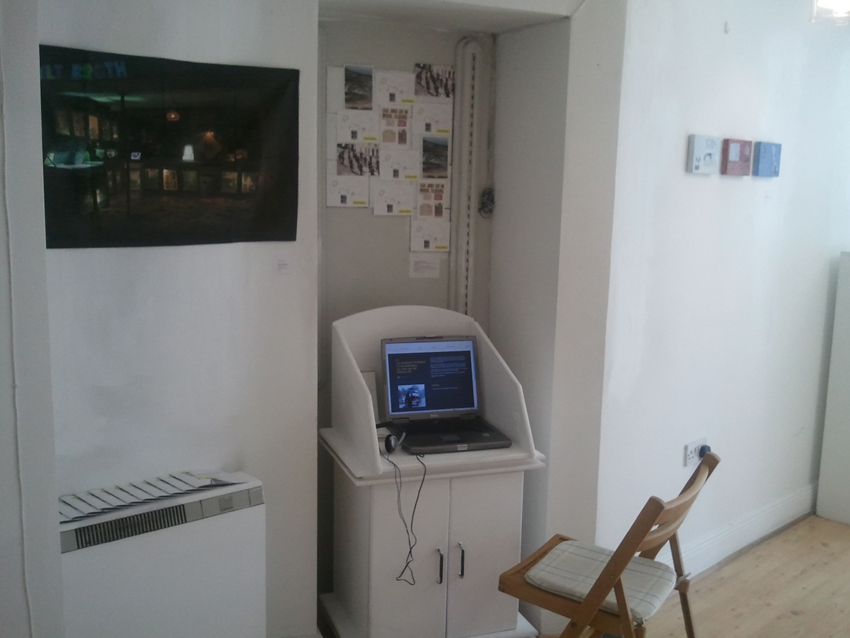
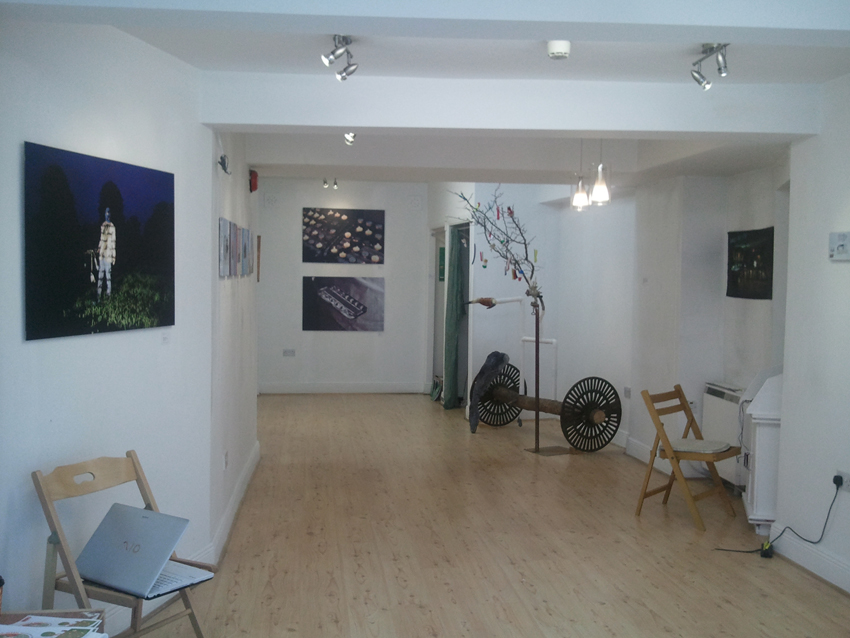
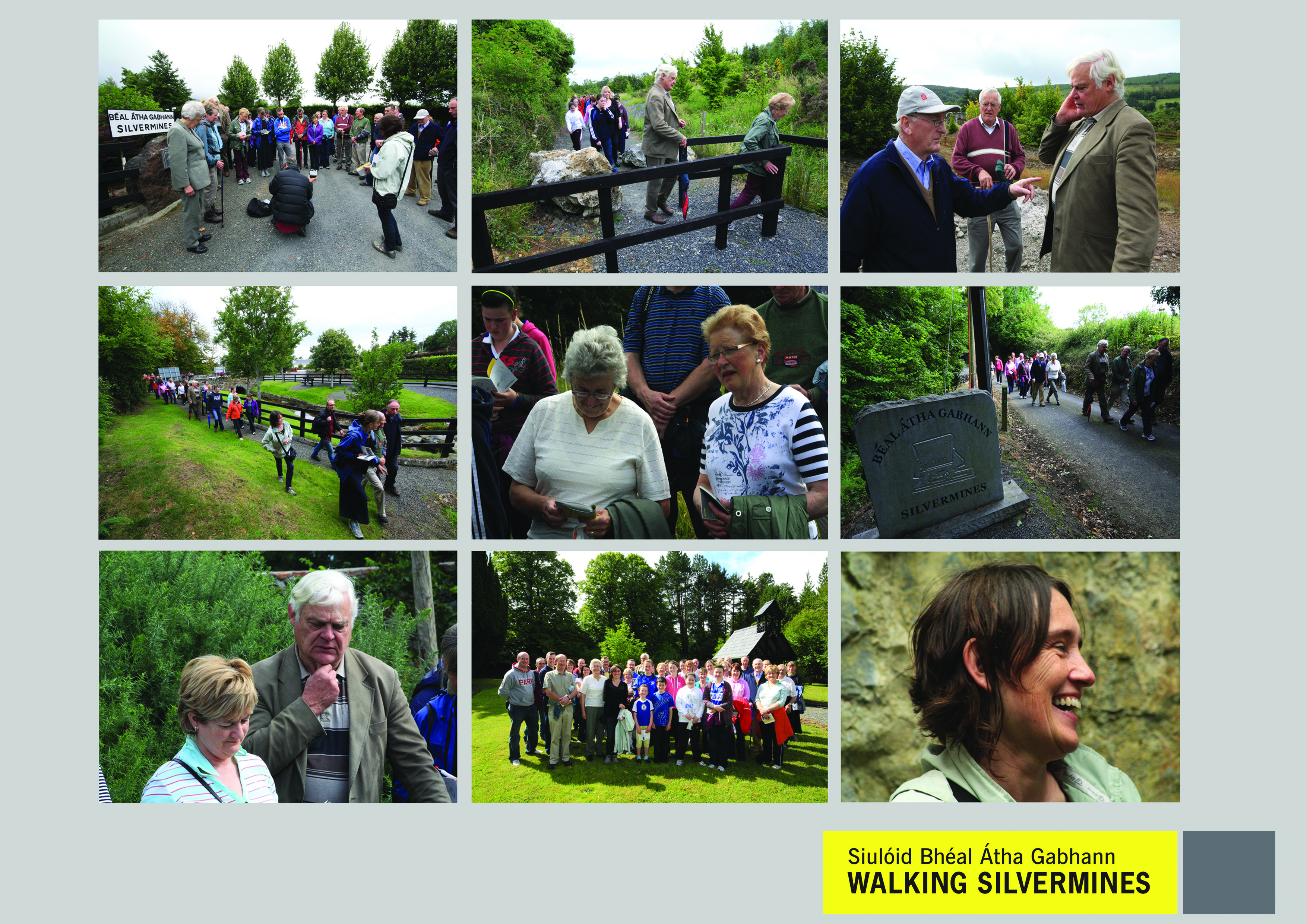
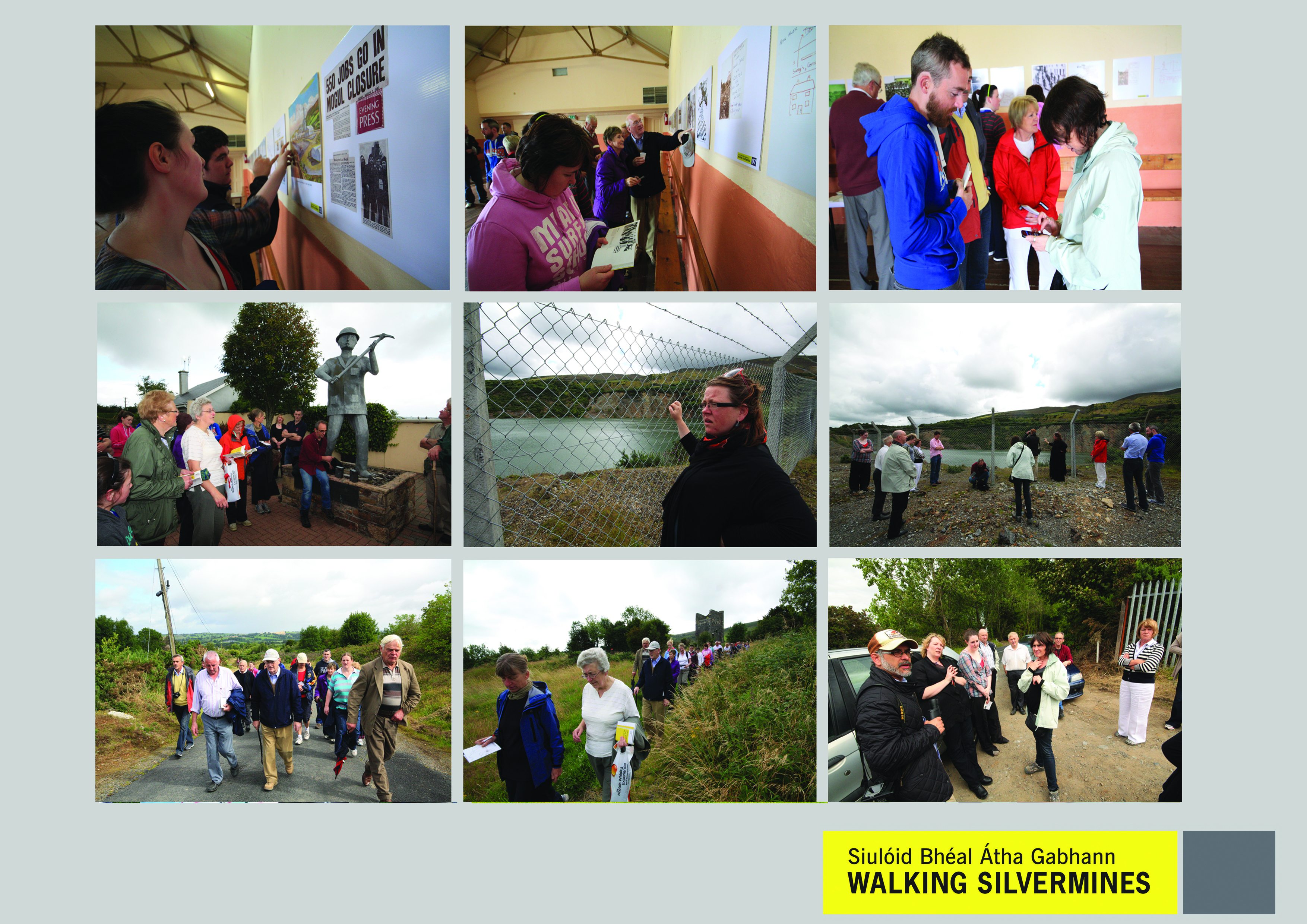
Walking Silvermines Launch
On Sunday 21st August 2011, the project Walking Silvermines was launched in Silvermines, Co. Tipperary. The launch took the form of a walk of the route, leaving St. Odhran’s Hall, Silvermines, at 10am, followed by lunch in the hall, and another walk of the second circuit after lunch. Copies of the guidebook Walking Silvermines were available, and stickers for use as part of the Guidebook Economy.
The weather gods were kind and it didn’t rain much. Thanks to all who traveled from near and far and made the day such a great one.
Photographs by Veronica Nicholson. Sound technician Andrew Collins.
Walking Silvermines guidebook now available
Design by David Wrenne, with artwork by Fiona Woods, Clive Moloney and Sally-Anne McFadden. Materials loaned, suggested and contributed by the people of Silvermines.
Book: 72pp, 120mm x 170mm
Map: 166mm x 708mm, concertina fold
Full colour throughout
100% recycled uncoated 115gsm on the inside, 250gsm on the cover
Printed by Plusprint, Dublin.
Price €6 including postage.
To order copies email
Posted in seminars and news |
Upload Guidebook
Posted in Uncategorized |Walking Silvermines on ABC radio, Australia.
Walking Silvermines has been featured on Artworks, the weekly Arts show on ABC radio, Australia.
Click the link below to view.
Play Recording
ENTRANCE TO FORMER SHALLEE MINE
First records of mine works at Shallee are in the 1790s when lead and silver was extracted and smelted onsite. In 1800 the owner of the land, Henry Sadlier Prittie was created Lord Dunally, and in 1802 the Dunally Mining Company was established with 11 principal shareholders. The company was not particularly successful (it wound up in 1804) and in 1845 a number of interests converged to set up the General Mining Company of Ireland (of which Lord Dunally was
a director).
“Employ the people, enrich yourselves” was the motto adopted by the General Mining Company of Ireland and records show that their employees ranged from 300 in 1849 to 700 in 1850 and 600 in 1853. 200 of these were men employed underground, 270 women and children working mostly at the surface and 170 tradesmen. By 1853 the ore near the surface had been exhausted; the editor of the Mining Journal made a visit to the mine in this year and found that miners were still being paid with meal, three years after the Famine had ended, and this mismanagement led to a miner’s strike that year. In 1854 miners sued the company for outstanding wages. Fortunes of the company fluctuated until 1870, when in a desperate attempt to raise money a subsidiary company, the Shallee Silver Lead Mining Company was set up. However, both ventures finally failed in the 1870s. Mining re-commenced in 1949 under the management of The Silvermines Lead and Zinc Company and these workings continued until 1953. The Shallee mine re-opened in 1955 and finally closed in 1958 having produced, during that period, in excess of 350,000 tonnes of ore. Although strikes were organised, mineworkers appear not to have been unionised until the period 1968 – 1982.
Source/ The Silvermines – Sporadic Working: 1289 – 1874 by Des Cowman, local conversations and artist notes
Artwork/ Fiona Woods & Clive Moloney
Posted in locations |GARRYARD/ ENTRANCE TO FORMER MOGUL MINE
Mogul Mine opened in 1968 and was operated until 1982 by Mogul of Ireland, registered in Canada. It currently has the status of an ‘orphaned’ or abandoned mine, meaning a mine site in which the mine operator or exploration company has ceased or indefinitely suspended their activities, but without rehabilitating the site. This was a large zinc-lead mine worked from shafts, now abandoned and flooded.
Production over the life of the mine amounted to 107 Mt at 7.36% Zn and 2.7% Pb. These minerals were both privately and State-owned. The State-owned minerals were worked under a State Mining Lease that was valid for 33 years from 1965 to December 1998. The mine-works site includes settlement ponds, a tailings lagoon and the mill where ore processing operations were carried out prior to export of concentrates for smelting. 3kms to the west of this site is the Gortmore Tailings Management Facility. In 1999, following a number of cattle deaths from lead poisoning in the area, an Inter Governmental Agency Group (IAG) was established to investigate the presence and influence of lead on animal and human health in the area. The stream from the Garryard mine complex had evidence of serious pollution caused by high concentrations of zinc, cadmium and lead. The high lead concentrations recorded in the stream leaving the Garryard complex contribute to the lead load in the Yellow River. Clause K of the State Mining Lease, issued to Mogul in 1965 under the Mineral Development Acts 1940 – 1960, enables the Minister for the Marine and Natural Resources to require specific works to be carried out on a once-off basis to rectify lands affected by the lessee‘s mining activity. At its height it employed just over 500 people, mostly men. A spur was built off the main Limerick to Dublin rail line to allow ore to be transported for export.
Source/ Local conversations and internet
Artwork/ Fiona Woods
Posted in locations |
JUNCTION OF LIMERICK RD. AND TRACK KNOWN AS CROMWELL’S ROAD
This site marks the spot known locally as Cromwell’s Road. Local lore says that Cromwell’s forces built the new road in 1650 in order to move their heavy artillery and troops to Limerick for the siege of Limerick. Cromwell himself had already left Ireland by the time that these forces were moving towards Limerick, under the command of Henry Ireton.
Cromwell’s status in Ireland is second only to ‘the devil himself’. As Winston Churchill said – ” ’Hell or Connaught’ were the terms he thrust upon the native inhabitants, and they for their part, across three hundred years, have used as their keenest expression of hatred ‘The Curse of Cromwell on you.’ … Upon all of us there still lies ‘the curse of Cromwell’.”
The original curse in Irish is ‘Malacht Cromail ort’.
Source/ Local conversations and internet
Artwork/ Clive Moloney
Posted in locations |
ENTRANCE TO FORMER MAGCOBAR MINE
This is the site of Ballynoe mine, which came to be known as Magcobar mine after it was taken over by the US mining company Magcobar.
In 1962, the Government of Ireland granted a license to Magcobar to operate an open-cast barite mine here at Garryard West. Barites are used in the production of drilling fluids for the oil industry. The surface area of the open-cast mine is approximately 15 hectares and the excavation approximately 70m deep with a capacity of 7 million cubic metres or thereabouts. The excavation has largely filled with surface and ground water since the mine closure in 1993. No remediation work was carried out following the closure of the mine leaving a number of spoil heaps with significant quantities of heavy metals.
Magcobar is an integral part of the water courses in the area. The main water course is the River Kilmastulla, with its source high in the Silvermines Mountains. On reaching the main valley floor, the river turns sharply to the west, eventually joining the Shannon River approximately 15km from the source. The river channel has been changed by mining activity. This has included deepening and straightening. Other changes have included river re-alignment to reduce peak flood levels and erosion, and culverting of tributary streams, such as at Magcobar.
The mining areas are drained by a number of streams feeding the Kilmastulla River: Ballygowan, south of the village, is drained by the Silvermines River; two tributaries of the Foilborrig River pass through Magcobar, and have been diverted around the Magcobar pit; the Garryard settling pond and lagoon feed tributaries of the Yellow River, and one tributary from the west of Magcobar has been diverted along the main road to avoid the Garryard plant area; an unnamed stream and its tributaries flow through the Shallee South/East area; the Kilmastulla River itself has been diverted around the perimeter of the Gortmore Tallings Pond.
In 1994 the Magcobar Quarry was purchased by Cussen Waste Disposal of Limerick with a view to developing a landfill site. This plan was resisted locally, and was not progressed any further until 1998 when Waste Management Ireland WMI (a subsidiary of Waste Management Inc., based in Houston, Texas) acquired an option on the site. Between 1998 and 1999 a huge campaign was launched by the local community and the Silvermines Environmental Action Group was formed. The dump was opposed on health and environmental grounds.
North Tipperary County Council granted a license to WMI to pump water out of the quarry, but this was overturned by An Bord Pleanála in November 2002. All plans to create a landfill site in the Magcobar Quarry were finally dropped. It was a huge victory for the people of Silvermines.
Source/ The internet, Silvermines Environmental Action Group newsletter and local conversations
Artwork/ Fiona Woods
Posted in locations |SINEY’S CORNER/ SILVERMINES
Siney’s Corner gets its name from Mrs. Siney’s sweetshop, which once stood on this site.
Siney’s Corner is also the birthplace of Cornelius Magrath, an Irish giant who lived from 1736 -1760. At the age of just 16 he travelled to Cork seeking medical advice about pains in his back. Whilst there, he was persuaded to join a circus and exhibit himself for money. In January of 1753 he was already a huge star in London as the press noted: “Just arrived in this city, from Ireland, the youth, mentioned lately in the newspapers, as the most extraordinary production in nature. He is allowed by the nobility and gentry, who daily resort to see him, to have the most stupendous and gigantic form (altho’ a boy), and is the only representation in the world of the ancient and magnificent giants of that kingdom. He is seven feet three inches in height, without shoes. His wrist measures a quarter of a yard and an inch. He greatly surpasses Cajanus the Swede, in the just proportions of his limbs; and is the truest and best proportioned figure ever seen. He was sixteen years of age the 10th of last March and is to be seen at the Peacock, at Charing Cross, from eight in the morning, till ten at night.”1
After touring England the young Magrath did short stints throughout all of Europe, where he was painted by the well-known Italian painter Pietro Longhi. He was forced to return to Ireland as his health rapidly began to decline, and he died soon after.
At his wake in Silvermines, students from Trinity College Dublin are believed to have ‘spiked’ the porter, and stolen his body. His bones were preserved, and can be seen on display to this day at Trinity College.
1. The Daily Advertiser, January 31, 1753
Source/ Internet, local conversations and the Irish Independent
Artwork/ Fiona Woods
Posted in locations | ← Older posts